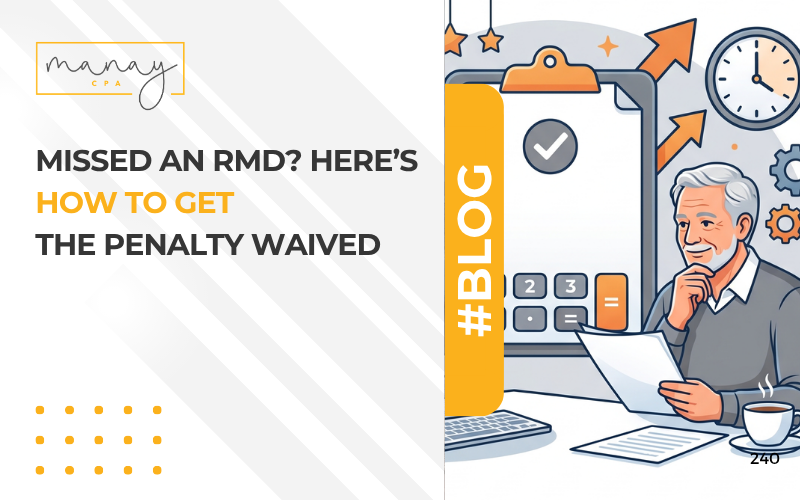

If you missed a Required Minimum Distribution (RMD), there’s a penalty involved, but it’s not automatic and it’s usually fixable. The steps below are in the order you would like to follow.
Take the Missed Withdrawal Right Away
Before doing anything else, withdraw the amount you should have taken out. This matters because every way to reduce or erase the penalty depends on you having already fixed the mistake. Filling out IRS forms before taking the money out doesn’t solve anything. The IRS wants to see that you’ve corrected the problem, not just that you’re aware of it.
Calculate the withdrawal the same way you normally would: take your account balance as of December 31 of the previous year, and divide it by a number the IRS provides based on your age (called a life expectancy factor; you can find it in an IRS table, or your account custodian can calculate it for you). Once you withdraw the money, it counts as taxable income for the year you actually take it ou. So if you missed a 2024 withdrawal and you’re fixing it in 2026, that money shows up as 2026 income, not 2024 income.
How the Penalty Actually Works
The penalty for missing an RMD is 25% of the amount you should have withdrawn but didn’t. Important detail: it’s 25% of the shortfall, not 25% of your entire required withdrawal. So if you were supposed to withdraw $20,000 and you only took out $12,000, the penalty applies to the missing $8,000 — not the full $20,000.
This 25% rate is actually already a reduction. A few years ago, the SECURE 2.0 Act cut the penalty in half, from 50% down to 25%.
There’s a second discount available on top of that. If you fix the mistake within 2 years of the year you missed it, the penalty drops even further, to 10%. So if you missed your 2024 withdrawal, you have until the end of 2026 to fix it and qualify for that lower 10% rate instead of 25%.
The Reasonable Cause Waiver
Here’s the part most people don’t realize: even the 10% penalty isn’t final. The IRS can waive the whole thing; if you had a good reason for missing the withdrawal and you’ve already fixed it. This isn’t automatic either. Tt requires an affirmative request supported by an explanation.
The IRS calls this a “reasonable cause” waiver. There’s no official checklist of acceptable reasons, but based on cases the IRS has actually approved, these situations tend to work in your favor:
- You or a close family member responsible for your finances had a serious illness or was incapacitated.
- Your spouse or a close family member passed away during the year the withdrawal was due.
- Your bank or account custodian made an error or gave you wrong information.
- You reasonably trusted incorrect advice from a financial advisor or tax preparer.
- There was a calculation mistake in figuring out how much you owed.
- A natural disaster or similar event got in the way.
What generally doesn’t work as an excuse: simply not knowing the rule existed, forgetting the deadline, or losing track of one account among several. These are common, honest mistakes — but on their own, they usually aren’t enough to convince the IRS.
How to Actually Ask for the Waiver
The waiver is requested using IRS Form 5329, Additional Taxes on Qualified Plans (Including IRAs) and Other Tax-Favored Accounts, specifically Part IX, which covers the excise tax on missed distributions.
The mechanics of the request are specific and easy to get wrong:
- Calculate the shortfall — Fill out Part IX of the form, working out the shortfall and which rate applies to you (25% or 10%), depending on whether you fixed it within that 2-year window.
- Mark it “RC” — Here’s the key step: on the line where you’d normally write in how much you owe, don’t write the tax amount if you’re asking for a waiver. Instead, write “0,” and next to it write “RC” (short for reasonable cause).
- Write your letter — Attach a written explanation. This is the most important part of the whole request; the form itself doesn’t give you room to explain your situation, so you need to write a separate letter.
- Use the correct year’s form — Use the form from the year you missed, not the year you’re filing. If you missed your withdrawal in 2024 and you’re fixing it in 2026, use the 2024 version of Form 5329.
- File separately per year/spouse — If you missed more than one year, file a separate form for each year. If you’re married and both of you missed a withdrawal, each of you files your own form.
- Attach to your return — Attach the form to your regular tax return for that year, or file it by itself if you don’t otherwise need to file a return.
The explanation statement should be specific rather than general: what happened, when it was discovered, when the corrective distribution was taken, and why the circumstances meet a reasonable cause standard. A vague or generic statement is less persuasive than one that lays out a clear, documented timeline.
What a Good Explanation Letter Should Include
There’s no required format, but a solid letter usually covers:
- Which account this involves, which tax year, and how much you missed.
- A plain, honest explanation of what happened — no need to over-explain.
- When you (or someone helping you) discover the mistake.
- When you took the corrective withdrawal, showing the problem is already fixed.
- Any documents that support your story, like medical records or letters from your bank, if you have them.
- A short closing line asking the IRS to waive the tax based on the reasonable cause you’ve described.
Since this letter is really the heart of your request, having a clear structure to follow — instead of starting from a blank page — makes a real difference in how convincing it reads.
What Happens Next
You won’t get a letter congratulating you on a successful waiver. If the IRS accepts your explanation, nothing else happens — no bill, no follow-up. If they don’t accept it, you’ll get a notice asking you to pay the tax (either 25% or 10%, whichever applies) plus interest calculated back to the original deadline. Even then, you can still respond to that notice or ask for it to be reconsidered.
Quick Recap
Missing an RMD is more common than most people think, and it’s usually fixable without losing a quarter of your money to a penalty. Fixing it quickly gets you a lower rate automatically, and a clear, honest explanation can often get the rest waived completely — as long as you’ve already corrected the mistake and your reasoning holds up.
Since the explanation letter carries most of the weight here, having a clear template to work from makes this whole process much less intimidating. At Manay CPA, we help clients put together a clear, well-documented reasonable-cause letter as part of reviewing the full situation, before anything goes near a tax return.
Sources
Internal Revenue Service (IRS) | Instructions for Form 5329 (2025)
Internal Revenue Service (IRS) | Retirement Plan and IRA Required Minimum Distributions FAQs
Internal Revenue Service (IRS) | Retirement topics – Required minimum distributions (RMDs)