

Start with the number that isn’t real.
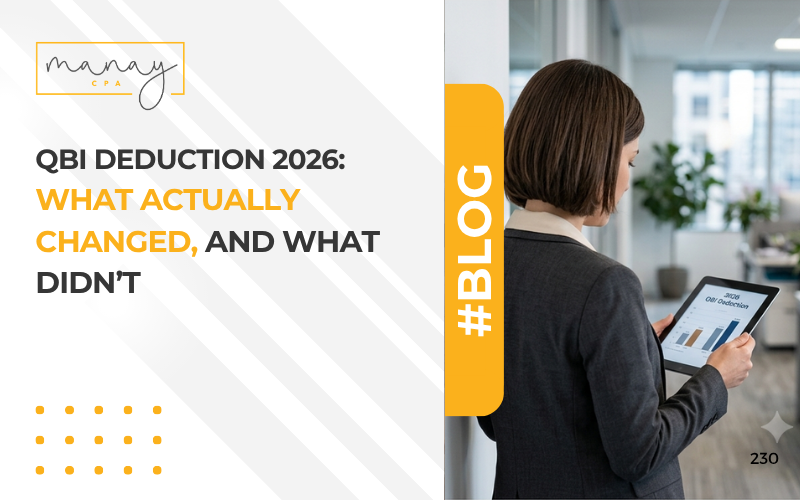
A lot of business owners are expecting a 23% qualified business income deduction this year. The House version of the 2025 tax bill did propose exactly that, striking “20 percent” from the statute and writing in “23 percent.” It did not survive. What Congress enacted keeps the rate at 20%, in every place the statute mentions it.
So if you have been told your QBI deduction went up, it did not. Three other things did change, and one of them is more restrictive than it sounds.
The short answer
The QBI deduction is now permanent. It survives at 20%, not 23%. Public Law 119-21 §70105 repealed the sunset that would have ended the deduction after 2025, widened the income range over which the deduction phases down, and added a new $400 minimum deduction for active business owners with at least $1,000 of qualified business income.
There is a quiet irony in how it was done. The subsection of IRC §199A that used to contain the expiration date, subsection (i), was repealed and replaced. The new subsection (i) is the $400 floor. The paragraph that once killed the deduction now guarantees a piece of it.
For most owners, though, the practical question is unchanged: where does your taxable income sit relative to the threshold, and is your business a specified service trade or business?
What actually changed
One. It is permanent. The old §199A(i) set the deduction to expire for tax years beginning after 31 December 2025. That paragraph is gone. No sunset, no scheduled cliff, no reason to accelerate income into 2025 for this purpose.
Two. The phase-in range widened by half. Above the threshold amount, the wage and property limitation does not slam on all at once. It phases in across a band. For 2026, IRC §199A(b)(3)(B) sets that band at $75,000 for single filers and $150,000 for joint filers, up from $50,000 and $100,000.
The same widened band governs the SSTB phaseout under §199A(d)(3). Practically, everyone in the transition zone now has more room to move, and a dollar of extra income costs less deduction than it did last year.
Three. There is a $400 floor. New §199A(i) grants a minimum deduction of $400 to an “applicable taxpayer,” defined as someone with at least $1,000 of aggregate QBI from active qualified trades or businesses. “Active” means you materially participate, in the §469(h) sense. Both the $400 and the $1,000 are indexed for inflation starting with tax years after 2026, using 2025 as the base year.
The $400 minimum, and who does not get it
Here is where nearly every summary of this provision stops short.
Read §199A(i) carefully. It applies to QBI from active qualified trades or businesses. Then look at §199A(d)(1): a specified service trade or business is expressly excluded from the definition of a qualified trade or business, except as provided in §199A(d)(3). And §199A(d)(3) only preserves SSTB treatment while taxable income stays below the threshold plus $75,000, or plus $150,000 for joint filers. At the top of that band the applicable percentage falls to zero.
Follow the chain. An SSTB owner above the upper threshold has no QBI from a qualified trade or business. No qualified trade or business means no applicable taxpayer status. No applicable taxpayer status means no $400.
So the consultant, the lawyer, and the physician earning $350,000 single get nothing. Not a reduced deduction. Not $400. Zero. And they are exactly the readers most likely to have gone looking for the minimum deduction after reading a headline about it.
Where you sit on the map
Three positions. Find yours before you read anything else about this deduction.
| Your 2026 taxable income | Single | Joint | What applies |
| Below the threshold | under $201,750 | under $403,500 | SSTB status is irrelevant. W-2 wages are irrelevant. Deduction is 20% of QBI, capped at 20% of taxable income less net capital gain. |
| In the phase-in range | $201,750 – $276,750 | $403,500 – $553,500 | The wage and property limit phases in. If you are an SSTB, your deduction phases out at the same time. |
| Above the range | over $276,750 | over $553,500 | Full wage and property limit. SSTB deduction is zero, no matter how large your wages or property. |
Two things follow from this table that are worth saying out loud.
Below the threshold, the QBI deduction is simple. It is 20%, and the complications people write articles about do not touch you. If you are here, stop worrying about SSTB classification. It does not matter.
Above the range, the deduction stops being about your income and starts being about your payroll. An owner with $2 million of QBI and no W-2 wages gets nothing except, possibly, $400. That is not a drafting accident. The provision was built to reward businesses that employ people or own assets.
What counts as a specified service trade or business
An SSTB is any trade or business in one of the fields §199A(d)(2) names, or any business whose principal asset is the reputation or skill of one or more of its owners or employees.
In: health, law, accounting, actuarial science, performing arts, consulting, athletics, financial services, brokerage services, investing and investment management, trading, and dealing in securities, partnership interests, or commodities.
Notably out: engineering and architecture. Both were in the predecessor statute and Congress left them out of this one. Real estate, construction, manufacturing, restaurants, e-commerce, and most trades are not SSTBs.
The category that causes the most argument is consulting, because it is defined by what you actually do rather than what your invoice says. Providing advice and counsel is consulting. Selling a product and providing support alongside it, where the support is not separately billed, generally is not. Firms have restructured billing arrangements around this line, and the regulations at Reg. §1.199A-5 contain more detail than most owners expect.
If your taxable income is below the threshold, none of this matters. Do not spend money on an SSTB analysis you do not need.
The wage and property limit
Once your taxable income clears the threshold, the deduction for each business becomes the lesser of:
- 20% of that business’s QBI, or
- the greater of 50% of the business’s W-2 wages, or 25% of its W-2 wages plus 2.5% of the unadjusted basis of its qualified property.
Below the threshold this limit is disregarded entirely. Inside the phase-in range it applies proportionally. Above the range it applies in full.
The 25%-plus-2.5% alternative exists for capital-intensive businesses with few employees. A real estate partnership holding buildings and paying almost no wages will usually find the second branch of the test more generous. A consulting firm with payroll but no assets will use the first.
Both branches are zero if you pay no wages and own no qualified property. That is the situation most single-owner service businesses find themselves in, and it is the reason the next section exists.
If you claimed the Employee Retention Credit, your W-2 wages are smaller than you think
Wages used to claim the Employee Retention Credit reduce — or drop out of — the W-2 wages you count for the Section 199A wage limitation, to the extent the wage deduction was disallowed under IRC §280C(a). The mechanism is easier to see than it sounds: Reg. §1.199A-2(b)(4) treats W-2 wages as properly allocable to QBI only if the associated wage expense was actually taken into account in computing QBI, and §199A(c)(3)(A) counts only items included or allowed in taxable income. Wages you could not deduct because of the ERC fail both tests.
This matters only if you are above the threshold, because that is where the wage test starts to bind. But when it binds, the difference is not cosmetic: a business that claimed a substantial ERC and then ran the limitation on its gross payroll figure will overstate its deduction. It is worth recomputing for any year in which an ERC claim was filed, or in which an amended return reflected one.
The S corporation salary question
This is the arithmetic that decides whether the QBI deduction is worth anything to a high-earning owner, and almost nobody publishes it.
Consider a single filer with $400,000 of taxable income and $370,000 of qualified business income from a non-SSTB business she operates as a sole proprietorship. She pays herself nothing, because a sole proprietor cannot. She has no qualified property.
She is above the upper threshold, so the wage and property limit applies in full. Fifty percent of zero wages is zero. Twenty-five percent of zero, plus 2.5% of zero property, is zero. Her deduction under the general rule is $0. Because she materially participates and her business is not an SSTB, the new floor gives her $400.
Now she elects S corporation status and pays herself a $100,000 salary.
Her QBI drops. The salary is a deduction to the business, so QBI falls from $370,000 to roughly $270,000. Twenty percent of that is $54,000. But she now has W-2 wages, so the limit is the greater of 50% of $100,000, which is $50,000, or 25% of $100,000 plus nothing, which is $25,000. The limit is $50,000.
Her deduction is the lesser of $54,000 and $50,000. $50,000.
She reduced her QBI by $100,000 and her deduction went from $400 to $50,000.
That is the whole game above the threshold. Wages are not a cost of the deduction; they are the raw material of it. Push the salary too low and the limit strangles the deduction, and the IRS has its own view about unreasonably low compensation. Push it too high and you shrink the QBI the deduction is calculated on, and you pay more payroll tax. There is an optimum, it moves with your income, and it is not something to guess at in March.
Two caveats worth stating plainly. The employer’s share of payroll tax is itself a business deduction, so it reduces QBI a little further than the arithmetic above suggests. And the payroll tax consequences of an S corporation election depend on the Social Security wage base and your other income, so the total picture is not just the QBI number. Run it before you elect, not after.
Which form do you file
If your taxable income is at or below the threshold and you have no patron reductions, you use Form 8995, which is one page.
If you are above the threshold, or you have an SSTB, or you are in the phase-in range, you use Form 8995-A, which is four schedules and considerably less pleasant. Which form you are handed is a reasonable proxy for how much this deduction is going to cost you in professional fees.
What quietly reduces your QBI
Qualified business income is net of the deductions attributable to the business, and several of them are easy to forget because they appear on Schedule 1 rather than on the business return.
The self-employed health insurance deduction under §162(l) reduces QBI. Reg. §1.199A-3(b)(1)(vi) says so directly. If you are an S corporation shareholder running premiums through your W-2, that deduction is shrinking the income your QBI deduction is calculated on. We wrote about how that mechanism works, and where it silently fails, in our piece on the S corp owner health insurance deduction.
Deductible retirement plan contributions and the deductible half of self-employment tax generally reduce QBI on the same principle.
None of this is a reason to skip those deductions. All of them are worth more than the 20% of themselves that you lose. It is a reason to model them together rather than one at a time.
Frequently asked questions
Is the QBI deduction 23% in 2026?
No. It is 20%. The House-passed version of the 2025 legislation would have amended §199A to replace “20 percent” with “23 percent,” but the enacted law, Pub. L. 119-21 §70105, did not include the increase. The 20% rate appears unchanged throughout the current statute.
Is the QBI deduction permanent now?
Yes. Pub. L. 119-21 §70105(b)(1) repealed the sunset in the old IRC §199A(i), which would have ended the deduction for tax years beginning after 2025. Permanent in the tax sense means no scheduled expiration, not that a future Congress cannot change it.
Who is eligible for the $400 minimum QBI deduction?
A taxpayer with at least $1,000 of aggregate QBI from active qualified trades or businesses, where “active” means material participation under §469(h). Both figures index for inflation beginning after 2026.
Does the $400 minimum apply to SSTBs?
Only below the top of the phase-in range. Above it, an SSTB is not a qualified trade or business under §199A(d)(1) and (d)(3), so its owner is not an applicable taxpayer and receives nothing. Not $400. Zero.
What are the 2026 QBI thresholds?
$201,750 of taxable income for single filers and $403,500 for joint filers. The phase-in band runs $75,000 above the single threshold and $150,000 above the joint one, ending at $276,750 and $553,500.
Does an S corporation election increase my QBI deduction?
It can, substantially, if you are above the threshold and currently pay no W-2 wages. The salary reduces QBI but creates the wage base the limitation is measured against. Below the threshold, where the wage limit is disregarded, an election does not help the QBI deduction at all.
Does the self-employed health insurance deduction reduce QBI?
Yes. Under Reg. §1.199A-3(b)(1)(vi), business deductions reduce QBI to the extent business gross income is used to compute them, and the §162(l) deduction is specifically included.
Can a non-U.S. resident claim the QBI deduction?
Only on income effectively connected with the conduct of a U.S. trade or business. IRC §199A(c)(3)(A)(i) and Reg. §1.199A-3(b)(2)(i)(A) impose that requirement. Foreign-source income and income that is not effectively connected do not produce QBI. Note separately that an S corporation cannot have a nonresident alien shareholder, so foreign founders usually encounter this question through an LLC or a partnership.
Where this leaves you
Most owners can work out in a few minutes whether they are below the threshold, inside the phase-in band, or above it. That is the easy part. What is harder is knowing what to do about it, and the useful answers involve decisions made months before the return is filed: entity structure, salary level, timing of income, retirement contributions.
If your taxable income is anywhere near the phase-in range, or you are weighing an S corporation election, the arithmetic is worth running with someone while you can still change the outcome. Manay CPA works with pass-through owners on exactly this calculation, from our office in Marietta, Georgia and with founders across the U.S. and abroad.
This article is general information, not tax advice. How §199A applies to you depends on your entity, your taxable income, your business activity, your W-2 wages, your property, and your residency. Talk to a qualified CPA before acting on anything here.
Sources: IRC §199A · Reg. §1.199A-1 through §1.199A-5 · IRC §469(h) · IRC §162(l) · Pub. L. 119-21 §70105 · Rev. Proc. 2025-32 · IRS, Qualified business income deduction · IRS, About Form 8995 · IRS, About Form 8995-A