
A client called us on the 27th of December two years ago, pleased with himself. He had just wired the deposit on a piece of equipment worth about four hundred thousand dollars and wanted to know how much it would save him that year.
Nothing. The machine shipped in the second week of January.
That is the whole problem with year-end equipment planning in one story. The money left his account in December. The deduction landed in the following year, because the only date the IRS cares about is the day the asset was ready and available for the job you bought it for.
What "placed in service" actually means
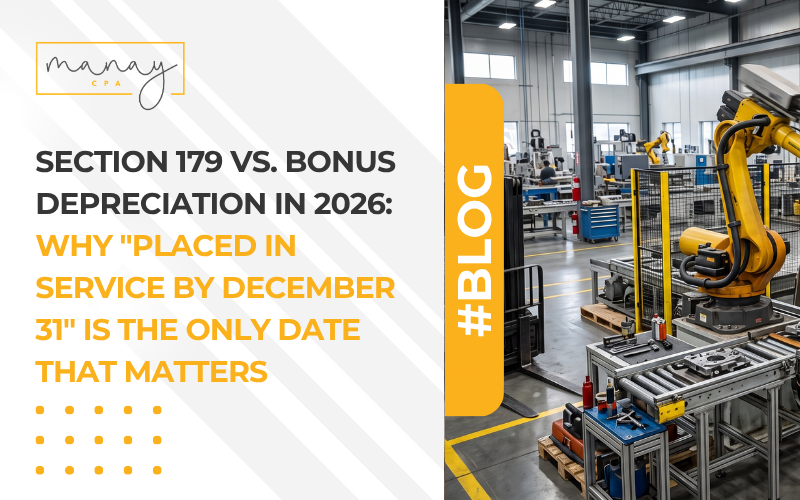
Placed in service is not the purchase date, not the invoice date, and not the delivery date. It is the point at which the asset is ready and available for its intended use. Two consequences follow, and both bite in December.
- An asset sitting on your loading dock in a crate is not in service. If it needs installation, calibration or a permit before you can run it, the clock starts when that is finished, not when the truck arrives.
- An asset can be in service before you actually use it. A backup generator installed and connected on December 20 is in service even if it never runs until March. Ready and available is the test, not used.
This also cuts in your favor more often than people expect. Financing does not matter. If the equipment is installed and operational on December 28 and you have not paid a cent of the loan, the deduction is still yours for that year.
The 2026 numbers
Two figures set the boundaries. For tax years beginning in 2026 the Section 179 dollar limit is $2,560,000, and the deduction begins to phase out dollar for dollar once you place more than $4,090,000 of qualifying property in service. At roughly $6,650,000 of purchases it is gone entirely.
Bonus depreciation is 100% and, after the One Big Beautiful Bill Act, permanent. The step-down schedule that everyone spent years planning around no longer exists. It applies to qualified property acquired after January 19, 2025, and there is a trap in that date: property is not treated as acquired after it if you signed a written binding contract on or before it. An old contract can therefore pull a 2026 delivery back under the previous rules.
Most small businesses will never come close to the Section 179 cap. That means the number that actually constrains you is not the cap at all. It is your taxable income.
The order of operations, which is where people go wrong
Section 179 and bonus depreciation are not alternatives you pick between. They stack, in a fixed order, and the order is what produces the outcome.
Section 179 applies first. It is limited to your business taxable income, so it cannot create a loss or make an existing loss bigger. Anything you cannot use is not lost, but it carries forward to a future year.
Bonus depreciation then applies to whatever basis is left. It has no income limitation at all. It can push you into a loss, and that loss can become a net operating loss you carry forward.
| Section 179 | Bonus depreciation | |
|---|---|---|
| Order of operations | Applied first | Applied to whatever basis is left |
| Income limitation | Capped at business taxable income; cannot create or increase a loss. Excess carries forward. | No income cap. Can create or deepen a loss, which may become an NOL. |
| Election granularity | Asset by asset, and you can expense part of an asset’s cost | All or nothing for an entire class of property for the year, unless you elect out |
| Real property | Can cover roofs, HVAC, fire protection and security systems on nonresidential buildings | Does not cover those structural components |
| Used property | Eligible if new to you | Eligible if new to you |
| State conformity | Most states allow it, often at a lower cap | Many states decouple entirely and require an addback |
Why the order matters in a loss year
Take a business expecting to break even in 2026 that buys $300,000 of equipment and puts it in service in November.
Elect Section 179 on all of it and you get nothing this year. Taxable income is zero, the deduction is capped at taxable income, and the whole $300,000 carries forward to a year you cannot predict.
Skip the Section 179 election and let bonus depreciation take the full $300,000 instead. Now you have a $300,000 loss, which becomes a net operating loss available against future profit, and in a pass-through it can offset the owner’s other income in the same year.
Same equipment, same date, same money. The election is the only variable, and in a loss year the intuitive choice is the wrong one.
The reverse also happens. A business with a single very profitable year and modest purchases may want Section 179 precisely because it is selective. You can expense one asset fully and depreciate another over its normal life, which is useful when you are managing income across a threshold such as the qualified business income deduction.
Georgia conforms on one and decouples on the other
Federal is only half the calculation, and in Georgia the two halves point in opposite directions.
Georgia conforms to the federal Section 179 increase. The Georgia limit for 2026 is the same $2,560,000 with the same $4,090,000 phase-out threshold, so a Section 179 election generally works the same on both returns.
Georgia does not adopt Section 168(k) at all, including the permanent 100% bonus depreciation. You compute Georgia depreciation without any bonus, add the federal depreciation back to Georgia income, and subtract the Georgia-computed figure instead. The write-off is not lost, but it is spread over the asset’s normal life rather than taken in year one.
That single difference reshapes the decision for a Georgia business. A purchase you were planning to run entirely through bonus depreciation gives you the full federal deduction and almost nothing at the state level this year. Electing Section 179 on the same asset gives you both, because Georgia follows Section 179. When the asset fits within the Section 179 cap and your taxable income can absorb it, Section 179 is frequently the better election in Georgia even where bonus would be simpler federally.
Georgia also does not adopt one Section 179 provision for certain real property, so the roof and HVAC categories need checking separately rather than assumed. And if you file in more than one state, expect to run different schedules for the same machine.
What qualifies, and one thing that does not
- Machinery, equipment, furniture, computers and off-the-shelf software.
- Qualified improvement property, meaning interior improvements to nonresidential buildings after they were placed in service.
- Roofs, HVAC, fire protection and alarm systems, and security systems on existing nonresidential buildings. These are Section 179 property, but they do not get bonus depreciation just because of that. Bonus reaches qualified improvement property as 15-year property; these four categories only qualify if they independently meet the interior-improvement definition, which a roof or a rooftop HVAC unit will not.
- Used equipment, as long as it is new to you and not acquired from a related party.
Inventory is not on that list and never has been, whatever you may have read. There are separate rules for small businesses treating inventory as non-incidental materials and supplies, and we cover those elsewhere.
Vehicles, briefly
Vehicles have their own regime and it is genuinely more complicated than the equipment rules. Vehicles over 6,000 pounds gross vehicle weight but under 14,000 have a separate Section 179 cap of $32,000 per vehicle for 2026, with bonus depreciation available on the remaining basis.
Lighter passenger automobiles fall under the Section 280F limits, and the gap between those and the equipment figures is the part that surprises people. For a passenger car placed in service in 2026, the first-year depreciation ceiling is $12,300 without bonus depreciation and $20,300 with it. Not $2,560,000. If the vehicle weighs under 6,000 pounds, everything else in this article is essentially irrelevant to it.
All of it depends on documented business use above 50%, and if that percentage drops in a later year the deduction is recaptured as income. We have written separately on the vehicle rules, and if a truck or SUV is the purchase you are considering, start there rather than here.
The December checklist
- Confirm the installation date in writing before you order, not after. Ask the vendor to commit to it.
- If installation will be tight, ask whether a partial delivery can be made operational on its own.
- Run a taxable income projection before you elect anything. The election depends on the number, and the number is knowable in November.
- Check your state’s treatment of bonus depreciation, especially if you file in more than one.
- Keep the invoice, the delivery record and the installation sign-off together. Placed-in-service disputes are won with documents, not recollection.
When not to elect at all
There are years when the right answer is to take normal depreciation and nothing else. If you expect to be in a materially higher bracket in two or three years, a deduction taken now at a low rate is worth less than the same deduction spread into higher-rate years. If you are close to a threshold that produces a credit or a deduction phase-out, a large write-off can cost you more than it saves.
The calculation is not difficult, but it does have to be done before December 31 rather than explained afterward.
Before you sign
Manay CPA models the Section 179 and bonus depreciation split against your actual projected income before you commit to a purchase, including the state treatment if you file in more than one. If a year-end equipment decision is in front of you, that conversation is worth having in November rather than the last week of December.
For the rest of the quarter, our 2026 year-end tax planning guide sets out what closes on December 31 for each entity type.